Shopify B2B Just Opened to Every Merchant — What You Actually Unlock (and What You Don't)

Shopify Just Removed the $2,300 Wall Around Wholesale — And Most Merchants Haven't Moved Yet
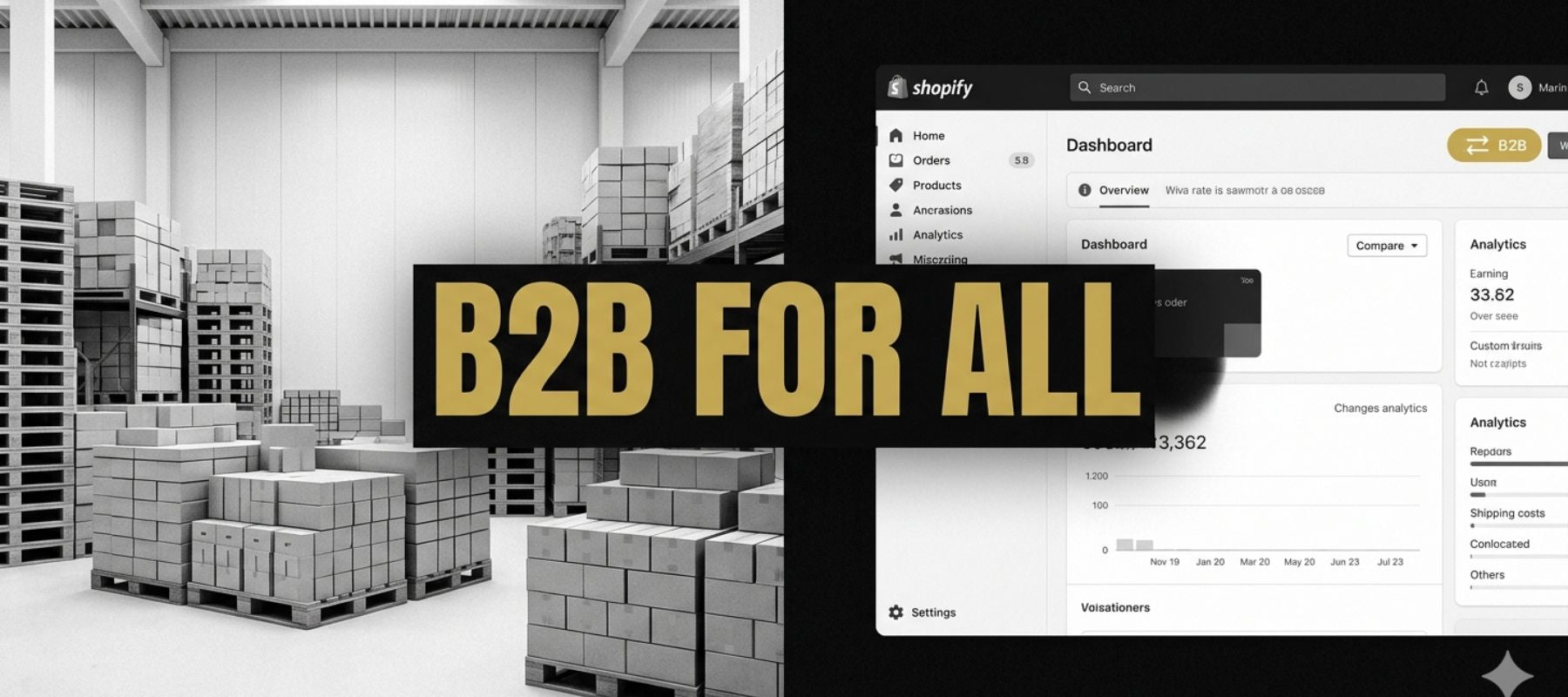
On April 2, 2026, Shopify flipped a switch that quietly ended nearly four years of Plus-only B2B exclusivity — extending native wholesale features to every Basic, Grow, and Advanced plan at no extra cost. This guide covers Shopify B2B for all plans end to end: what actually unlocks, where the 3-catalog cap bites, and the exact moves that separate merchants capturing the wholesale upside from those still quoting bulk orders by email. Activation and optimization are two different things. The gap between them is where your competitors are eating your lunch right now.
- On April 2, 2026, Shopify extended native B2B features to Basic, Grow, and Advanced plans for the first time — ending nearly four years of Plus-only exclusivity at $2,300/month.
- Every paid plan now gets company profiles, up to 3 custom catalogs, volume pricing, quantity rules, vaulted credit cards, and payment terms natively. No plugins, no workarounds.
- Merchants using B2B see up to 4.1x higher reorder frequency than DTC. B2B already influences roughly 30% of Shopify GMV. This is the biggest structural change in years.
- The 3-catalog cap and markets-only catalog assignment are the first walls you'll hit. Per-company pricing and unlimited catalogs remain Plus-only.
- Q1 2026 earnings drop on May 7. Merchants who activate before then are in the first wave of platform investment and roadmap prioritization.
Table of Contents
- What Actually Unlocks on April 2
- Why This Change Is Bigger Than It Looks
- Where the Limits Still Bite
- What to Do This Week
- Who This Helps Most
- Summary
- Frequently Asked Questions
- Sources
A customer emails you asking for bulk pricing. Ten units, maybe twenty. They mention a trade show, a retail buyer, a reorder cycle. You've had this conversation a dozen times. Every time you either quoted manually over email, built a scrappy workaround using discount codes and locked pages, or paid $2,300 a month for Shopify Plus you didn't otherwise need. If you're running a Shopify store and haven't checked whether your admin now shows the B2B channel active, you should build the AI brand intelligence layer your wholesale buyers will interact with before reading another word.
What Actually Unlocks on April 2 (And Why You're Already Eligible)
Native B2B on Shopify is a single-setup pipeline that gives you company profiles, custom catalogs, volume pricing, payment terms, and a B2B-specific checkout — all managed from the same admin as your DTC store. No apps. No plugins. No $2,300/month upgrade. Orders flow into the same inventory system with wholesale attribution.
The rollout: what happened and what it means for your store
On April 2, 2026, Shopify announced that native B2B features would become available on Basic, Grow, and Advanced plans — not just Plus. For the first time, merchants on every paid tier can manage wholesale and DTC from a single platform with no plugins or patchwork, as Shopify's own announcement framed it. The rollout was announcement-then-available, not default-on like Agentic Storefronts. You have to activate it. But you no longer have to pay Plus pricing to unlock it.
Why activation and optimization are not the same thing
This is the central tension of the entire rollout. Activating B2B means you've enabled the feature set in your admin. Optimizing B2B means you've built company profiles, structured your catalogs, set up payment terms, and wired the wholesale channel into your fulfillment operation. Those two states have a wide gap between them, and that gap is where most merchants will lose the opportunity.
Company Profiles
You can now create company records inside Shopify, separate from individual customer accounts. Each company has its own locations, billing addresses, payment terms, and assigned catalogs. This is how wholesale differs from DTC at the data model level — you're not selling to a person, you're selling to an account with multiple buyers, multiple addresses, and negotiated terms.
Custom Catalogs (Up to 3)
You can build up to three distinct B2B catalogs across all your markets combined. Each catalog can include specific products, percentage-based price adjustments, fixed prices per variant, quantity rules, and volume pricing. This is the pricing engine most merchants needed Plus for. It's now native on Basic.
Volume Pricing and Quantity Rules
Buy 10, get a per-unit discount. Buy 50, get a bigger one. Set minimum order quantities per product. Require order-size increments. These rules apply per catalog, so your wholesale tier pricing stays separated from your DTC price book.
Payment Terms and Vaulted Cards
Net 15, Net 30, Net 60, or custom terms per company. B2B checkout stores wholesale buyer payment methods securely, so repeat ordering is one click. These are the workflows that make B2B reordering frictionless — and they're exactly why B2B revenue reorders more aggressively than DTC.
Full Integration With Existing Shopify Stack
Shopify Flow, Markets, Shopify Payments, POS — everything you already rely on for DTC now works for B2B automatically. No separate system. No duplicate inventory. One store, two channels, same admin.
Why This Change Is Bigger Than It Looks
Three numbers tell the story.
The $36 trillion market you were locked out of
The global B2B e-commerce market is estimated at roughly $36 trillion — far larger than DTC e-commerce. Until April 2, small Shopify merchants watched that market from the sideline unless they paid $27,600 a year for Plus. That wall is gone. For merchants who've been selling DTC and occasionally fielding wholesale requests through email, the addressable market just expanded by orders of magnitude.
B2B already runs roughly 30% of Shopify GMV
According to Nova Analytics' April 2026 analysis, B2B influences roughly 30% of total Shopify GMV. Wholesale isn't a niche Shopify is dabbling in. It's a third of the platform's processed volume, and now it's accessible from every tier. The implication: Shopify's engineering, product, and support investment in B2B will continue to prioritize features that matter to non-Plus merchants, because that tier just became a much larger portion of the active B2B user base.
4.1x reorder frequency versus DTC
Shopify reports that merchants using B2B see up to a 4.1x increase in reorder frequency compared to DTC orders. A wholesale buyer, once activated, reorders roughly four times more often than a retail customer. That's not a marginal improvement — that's a fundamentally different customer lifetime value profile. Translation: if even a small percentage of your existing DTC customers convert to B2B accounts, your revenue curve bends meaningfully upward without acquiring a single new customer.
"Merchants are telling us wholesale buyers are already asking to purchase their products. But too often, B2B tools have lived outside the systems they use to run their business. By bringing these capabilities to more merchants on Shopify, we're making it easier for them to seize one of their biggest opportunities to grow." — Samir Pradhan, VP of Product, Shopify
Where the Limits Still Bite (And When to Pay for More)
Every rollout comes with ceilings. Here are the three you'll hit first on Basic, Grow, or Advanced plans.
The 3-Catalog Cap
You get up to three active B2B catalogs total — across all your markets combined, not per market. For a merchant with one wholesale tier, one distributor tier, and one key-account tier, that's fine. For a merchant with twelve buyer segments each needing different pricing, you're still looking at Plus, or at a B2B app like Wholesale Pricing Discount that starts at $25/month and bypasses the cap.
Catalog Assignment Is Market-Based, Not Per-Company
On Basic, Grow, and Advanced, you assign catalogs through Shopify Markets — meaning all companies in a given market share the same catalog. Per-company pricing, where every buyer has their own negotiated price book, remains a Plus-only feature. If you price differently for every single account, the native tier won't carry you past your first few wholesale customers.
Some Features Need Support Activation
B2B discount codes and abandoned checkout emails are reportedly off by default and require contacting Shopify Support to enable. Cart-level discounts, wholesale registration forms, per-tier shipping, content locking, and POS B2B pricing are not part of the native stack at any plan below Plus. If your B2B model depends on those workflows, native isn't enough.
What to Do This Week (Before Q1 Earnings on May 7)
If you run a Shopify store on any paid plan, three actions matter in the next seven days.
1. Audit whether you already have wholesale demand
Check your customer service inbox from the last 90 days. How many emails asked about bulk pricing, trade accounts, or reseller terms? If that number is above zero, you have latent wholesale demand you were losing to friction. Now you have a native system to capture it. This is often the single most underestimated asset in a DTC merchant's inbox — buyers who raised their hand and got ignored because the infrastructure wasn't there.
2. Build your first catalog before May 7
Shopify reports Q1 2026 earnings on May 7, 2026. Expect meaningful commentary about early B2B adoption. If your store is already operating on native B2B by then, you're in the first wave — which matters because Shopify's product roadmap prioritizes feedback from active early users. Waiting three months puts you behind merchants who moved in April, on a platform where feedback-to-feature velocity is unusually fast.
3. Map your product data for AI discovery alongside B2B
This is the part most merchants will miss. Shopify's agentic commerce push — products being surfaced inside ChatGPT, Microsoft Copilot, Google AI Mode, and Gemini — is running in parallel with the B2B rollout. A wholesale buyer discovering your catalog through an AI agent in 2026 is an entirely new acquisition channel. Your product data needs to be structured for both DTC shoppers and B2B buyers searching through AI. If you're running a catalog above a few hundred SKUs and haven't optimized for AI discoverability yet, Nexus SEO handles that catalog-scale optimization specifically. Small merchants can handle this manually. Anything above 500 products needs automation.
Who This Helps Most (And Who Still Needs Plus)
Three merchant profiles benefit asymmetrically from this change.
The DTC brand with organic wholesale demand. You've been manually quoting bulk orders for a year. You lose half of them to friction. Now you route those buyers to a native B2B checkout and capture the full LTV uplift. This is the profile most likely to see immediate revenue impact from activation.
The product manufacturer with existing retail relationships. You already sell to retailers via phone, email, and spreadsheets. Native B2B replaces that workflow with real software — company profiles, payment terms, reorder flows, Shopify Flow automations. The operational drag of managing 30 wholesale accounts becomes trivial.
The multi-channel seller already on Amazon and Walmart. Adding wholesale to your Shopify store opens a second revenue line on top of existing marketplace GMV, without building new infrastructure. Against 2026's Amazon fee increases, channel diversification via wholesale is suddenly cheap. If you want to master your full Shopify channel strategy including how B2B fits alongside DTC, paid acquisition, and marketplace channels, that's where the operator-level work lives.
The one profile this doesn't help: merchants with deeply segmented B2B pricing, dozens of customer-specific catalogs, or complex wholesale registration flows. That merchant still needs Plus, or a specialist B2B app on top of the native stack.
Summary
- Shopify extended native B2B to every paid plan on April 2, 2026 — ending nearly four years of Plus-only exclusivity and removing the $2,300/month wall around wholesale.
- Basic, Grow, and Advanced now include company profiles, up to 3 custom catalogs, volume pricing, quantity rules, vaulted credit cards, payment terms, and B2B-specific checkout natively.
- B2B reorder frequency runs up to 4.1x higher than DTC, and B2B already drives roughly 30% of total Shopify GMV.
- The 3-catalog cap across all markets and the markets-based catalog assignment are the first ceilings non-Plus merchants hit.
- Native works for most small-to-mid merchants; apps like Wholesale Pricing Discount ($25/month) extend it without requiring Plus.
- If your store gets bulk pricing inquiries monthly, you're leaving revenue on the table by not activating native B2B this week.
- Q1 2026 earnings on May 7 will set platform priorities for the rest of the year — early activators are in the first wave of roadmap attention.
- Pair B2B activation with AI-catalog optimization: wholesale buyers are increasingly discovering products through ChatGPT, Copilot, and AI agents, not Google alone.
Frequently Asked Questions
Is Shopify B2B really free on Basic plans now?
Yes — as of April 2, 2026, the native B2B feature set (company profiles, up to 3 catalogs, volume pricing, quantity rules, vaulted cards, payment terms, B2B checkout) is included at no extra cost on Basic, Grow, and Advanced plans. Shopify Plus at $2,300/month still gets unlimited catalogs and per-company pricing, but the core wholesale engine is now native on every paid tier.
Can I run wholesale and DTC from the same Shopify store?
Yes. That's the entire point of the rollout. One storefront, one admin, one inventory system — but B2B buyers log in through a separate company account with their catalog, pricing, and payment terms applied automatically. DTC customers shop the normal storefront unaffected.
What's the difference between native B2B and a wholesale app?
Native B2B is built into Shopify admin, integrates directly with Shopify Flow, Markets, and Payments, and requires no subscription beyond your existing plan. Wholesale apps (Wholesale Pricing Discount, SparkLayer, and others) add features the native stack doesn't cover — per-customer pricing, unlimited catalogs, registration forms, tier-based shipping. Start native; add apps only when you hit a specific wall.
Will this affect my DTC store's performance or SEO?
No. B2B runs as a separate customer experience layer. Your DTC storefront, product pages, SEO, and public catalog are unchanged. B2B buyers authenticate into a different shopping experience; unauthenticated visitors still see your normal DTC store.
How does B2B fit with AI-agent commerce and ChatGPT product recommendations?
This is the underappreciated angle. As more B2B buyers search via AI agents like ChatGPT, Perplexity, and Google AI Mode, your product data structure matters as much for wholesale discovery as it does for DTC. Optimizing your catalog for AI visibility — structured product data, conversational product descriptions, FAQ schema, clean GTINs and Google Product Categories — benefits both channels simultaneously. For stores above 500 SKUs, catalog-scale optimization is the next competitive edge.
When should I upgrade from native B2B to Shopify Plus or a B2B app?
Upgrade to Plus when you need unlimited catalogs or per-company pricing at scale — typically somewhere past 10–15 distinct buyer segments. Add a B2B app like Wholesale Pricing Discount when you need specific features native doesn't cover (wholesale signup forms, per-tier shipping rules, cart-level discount codes) but you're not ready for $2,300/month.
How does this connect to Shopify Q1 2026 earnings on May 7?
Expect meaningful commentary about early B2B adoption on non-Plus tiers, merchant activation numbers, and GMV contribution from the newly-enabled merchant base. Shopify is likely to frame this rollout as a key growth driver for the quarter — meaning early-activated merchants are more likely to see continued platform investment and feature prioritization in B2B through the rest of 2026.
Sources
- Shopify News — "Shopify brings native B2B features to millions more merchants" (April 2, 2026)
- Digital Commerce 360 — "Shopify adds B2B features for more merchants" (includes Samir Pradhan quote, April 3, 2026)
- Retailbiz — "Shopify rolls out native B2B tools across all plans"
- i95dev — "Shopify B2B Now Available on All Plans: About, Features & What It Means for Merchants"
- WholesaleHelper — "Shopify B2B on All Plans: Everything You Need to Know"
- WholesaleHelper — "How to Set Up a B2B Catalogue in Shopify (2026)"
- Nova Analytics — "Shopify Opens Native B2B to Every Paid Plan in April 2026"
- SparkLayer — "Shopify B2B on All Plans — What It Means for Wholesale Merchants"
- ChannelX — "Shopify brings native B2B features to millions more merchants"